

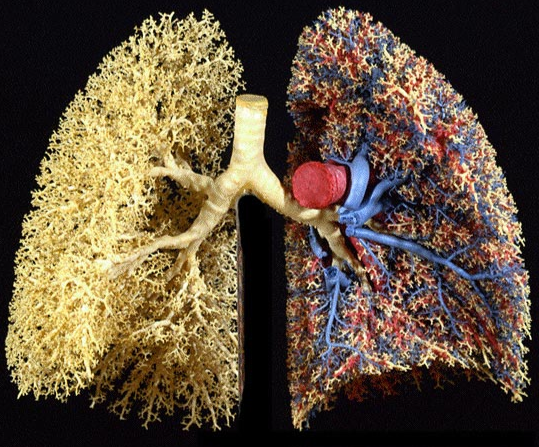
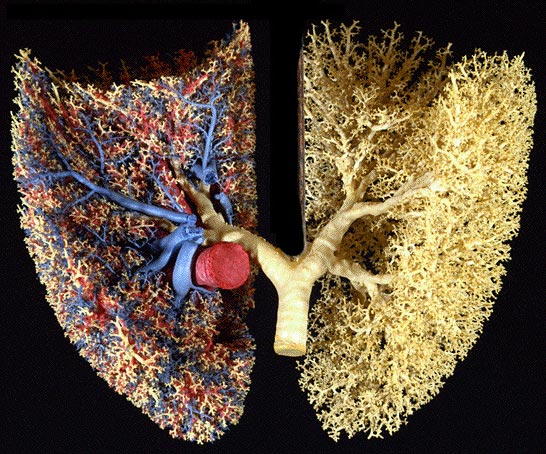








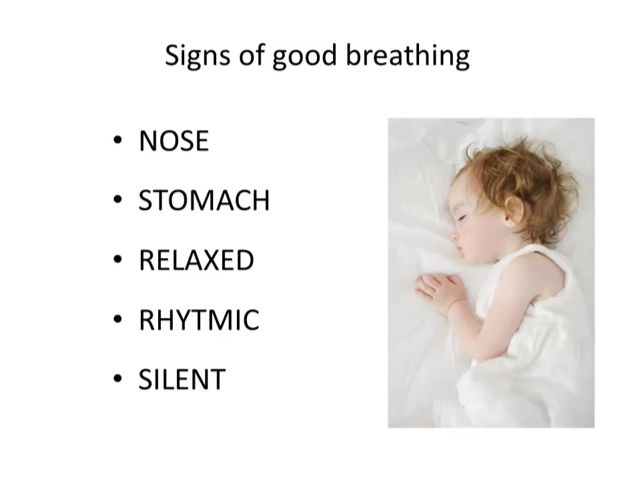
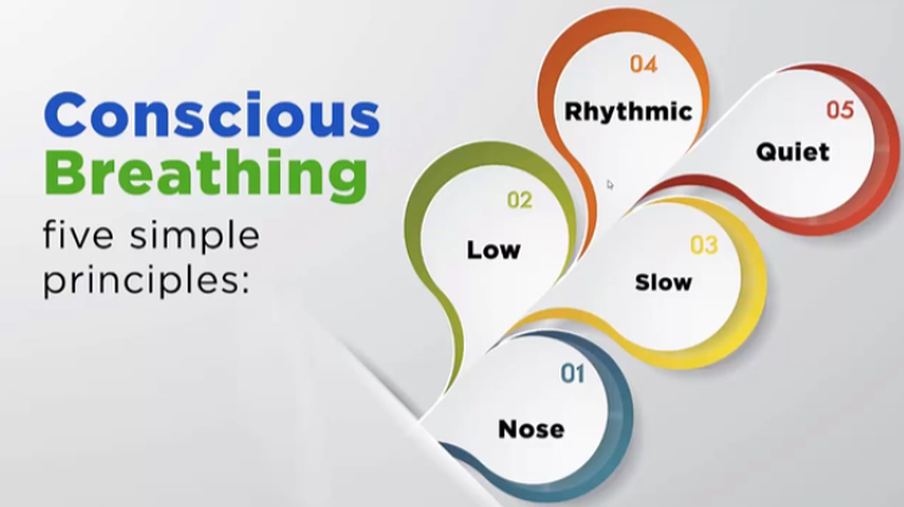





Good breathing should be slower, and more relaxed and harmonious.
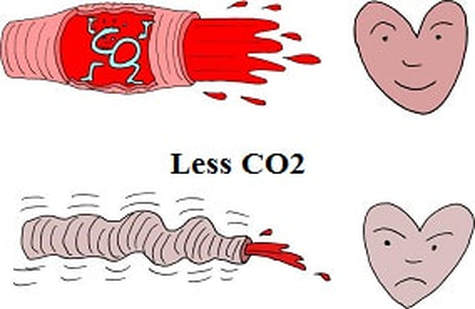
When we slow down breathing, we get a balance of O2 and CO2.
Need to breathe more slowly, average person breathes WAY too much and too fast (and labored) mainly because of stress and bad breathing habits.
It’s like overeating, not good for our health and interestingly can cause a lot of the same diseases as overeating. Lets to oxygen constipation.
Prolong exhalation and anchor yourself. Outbreathe connected to relaxation.
2-3 in
3-4 out
2-3 pause
Not belly breathing like a basketball in and out, think more like
air down
air up

Our breathe should be rhythmic like waves crashing on the shore on a nice day. Most things in Universe have a rhythm
Nights, days, seasons, moon, heart rhythm, hormone cycles, brain rhythms.
Rhythmic movements feel good!
Foot on gas one second, foot on the break the next. That is very unpleasant.
Sigh of relief danger is gone… prolong exhalation… tied to relaxation.
All processes in the body affect each other. The organs interact like cogs in an old fashioned clock where each cog engages with each other. If ONLY one cog is deteriorating it affects all other cogs. Heart, Brain and Breathing rhythms are the biggest and most influential COGS. Rhythmic breathing entrains rhythmic heartbeats, mind and bodywide coherence.
When we make a sound we are moving air in and out of lungs
Sighing, coughing, sniffling, snoring, clear throat, clear nose, noises, yawning… why am I making noises.
Every sound we make means we are mouth breathing because air moving through vocal cords.
big, unrhythmic…
Not natural to make these kind of sounds. Antelope snoring would get eaten at night.
Become aware of sounds you make during the day
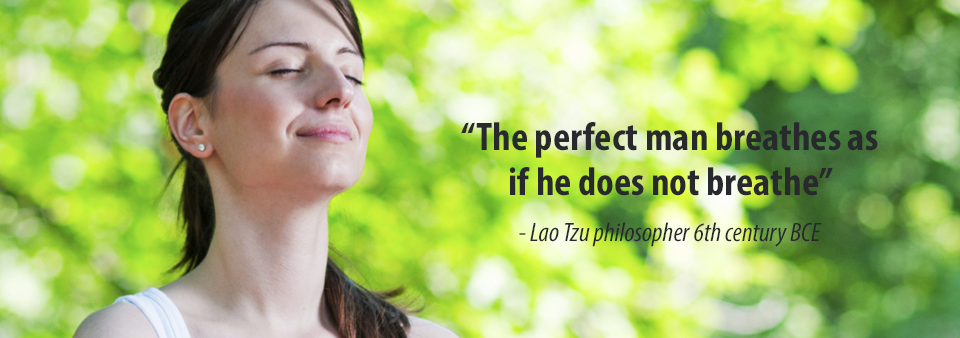
“The Perfect Man Breathes As if He Does Not Breathe”
-Lao Tzu
Quiet, not much movement, relaxed, Stillness
If you talk a lot, REALLY pay attention to your breathing habits.
Talking fast like eating fast… Inhale through the nose and talk slower.
People listen with mouth open waiting to say something and probably not listening well.
People take a big breathe before talking (hyperventilating) not necessary.
(Goes hand in hand with Nose Breathing!)
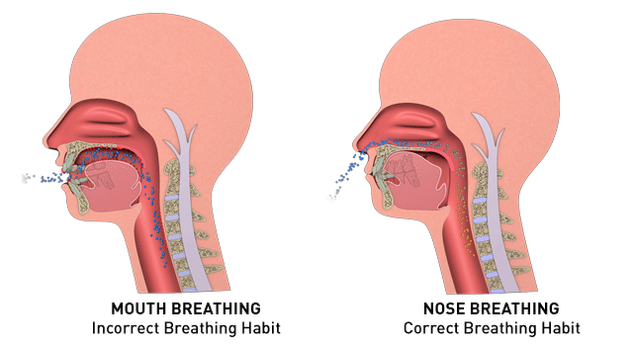
Tongue is our natural Retainer holding teeth in right place.
MOuth breathing tongue goes to bottom or middle of mouth (lower part of palette)
Tongue will not stimulate the maxilla bone. Big bone roof of mouth, part of cheek and supports 2/3 eye.
Swallow 2000 times a day. If tongue on roof of mouth, every time we swallow, it pushes maxilla up and forward. More importantly putting tongue on roof of mouth ENCOURAGES and ACTIVATES Nose breathing
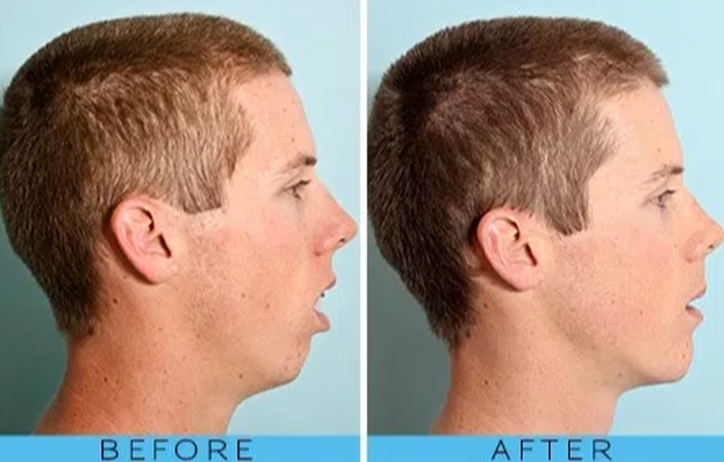
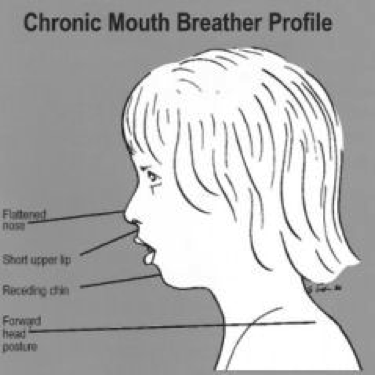
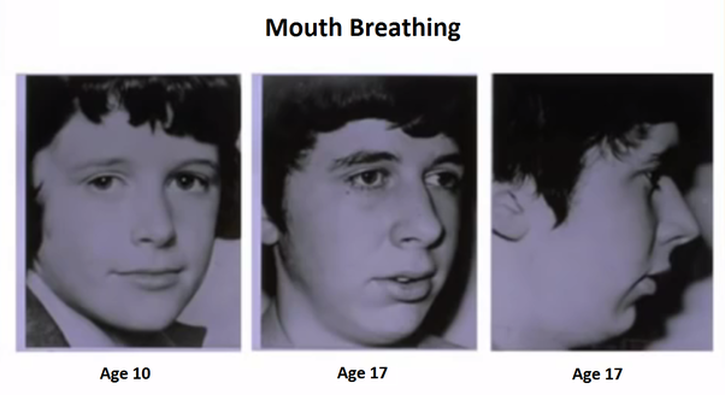
Facial structure – u shaped –> v shaped (than you need braces, retainers).
Affects looks
Affects teeth
Affects Neck vertebrae and restricts airways
Say NNNNNNNN
Suck tongue to the palate and seal tongue to palate
Our breathing should be quiet, relaxed and rhythmic in and out through the nose ONLY, with tongue on roof of mouth, very slow w/ longer exhalation and pause between breathes, deep/low in the diaphragm using the diaphragm muscles (see exercises below) and try to having breathing awareness to keep this up.
FOCUS ON BREATHING IN AND OUT THROUGH YOUR NOSE DAY AND NIGHT (when you are not talking or eating).
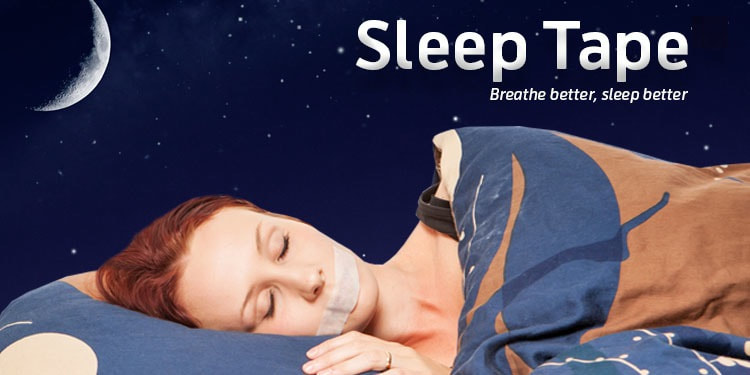
Taping Your Mouth during the day (when possible) and at night is a GREAT way to help with retraining your breathing through the Nose.
Taping the mouth might sound barbaric but it is ONE OF THE BEST (and easiest things) you can do to improve your sleep, breathing and health. Again this is breathing retraining to get back to nose breathing with tongue on roof of mouth.
1) Improves Sleep
2) Improves O2/CO2 balance and will boost your Energy and lower your stress the next day.
3) Get’s rid of snoring and sleep apnea (which are due to mouth breathing)
4) Most importantly gets you in the habit of breathing through your nose.
Tape mouth in day to relearn to get into habit of nasal breathing.
5) You will talk less and Listen more (talking consumes energy and encourages mouth breathing.
6) Get’s rid of snuffy noses and blocked airways
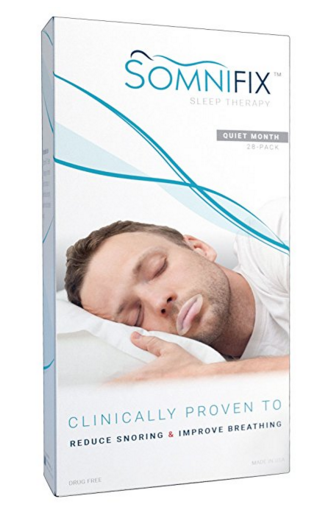
Sleep Tape and Somnifix is the brands I currently use and recommend to START with Somnifix because it has a breathing vent.
https://www.amazon.com/Sleep-Strips-SomniFix-Breathing-Nighttime/dp/B076CQ1NR8/ref=sr_1_1_sspa
You may want to work up to sleep tape or a brand that really seals the mouth like sleep tape at consciousbreathing.com
Feedback from using sleep tape:
-Wake up more alert
-Sleep more calmly and peacefully
-don’t wake up as often in the night
-need less sleep
Why do I have a blocked Nose?
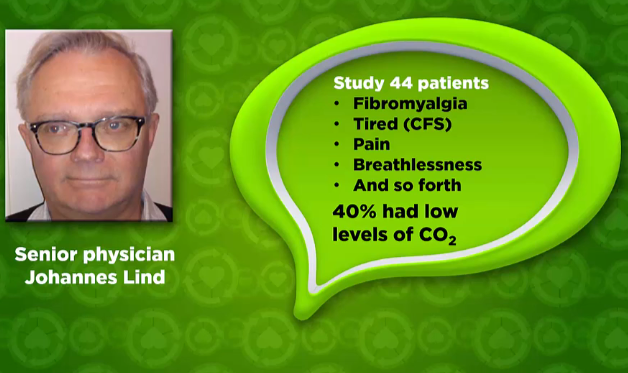
Poor breathing habits lack of carbon dioxide.
Block nose disappears once you really start breathing through the nose.
You can also use a Neti pot to cleanse the nose. But the KEY to unblocking a stuffed nose is breathing retraining to breathe through the nose with tongue on the roof of the mouth.
Give it a week.
Stick with it – pun intended…lol.. Seriously this is one of the best NEW things I have learned.
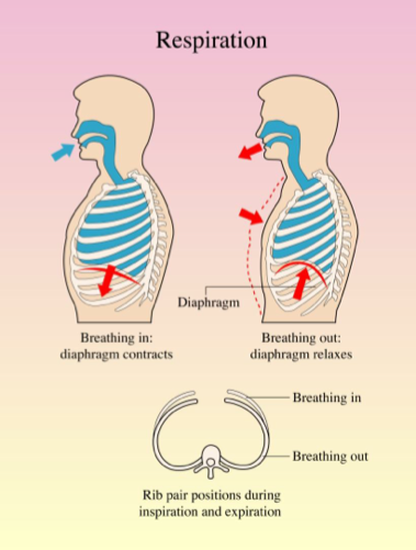
How to Breathe MORE with Your Diaphragm (70-80%)
Let’s First do a couple exercises to GET in touch with your diaphragm..
Then We’ll look at the best breathing retrainer tool to strengthen your diaphragm and help you breathe more deep/low, rhythmic and relaxed.
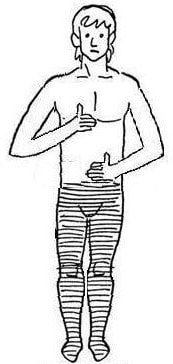
A. Exercise to see if you are breathing with your diaphragm
- Stand or Sit Upright and place one hand on your chest and one on your stomach
- Breathe in and out in a relaxed manner
- Strive to fill your stomach first
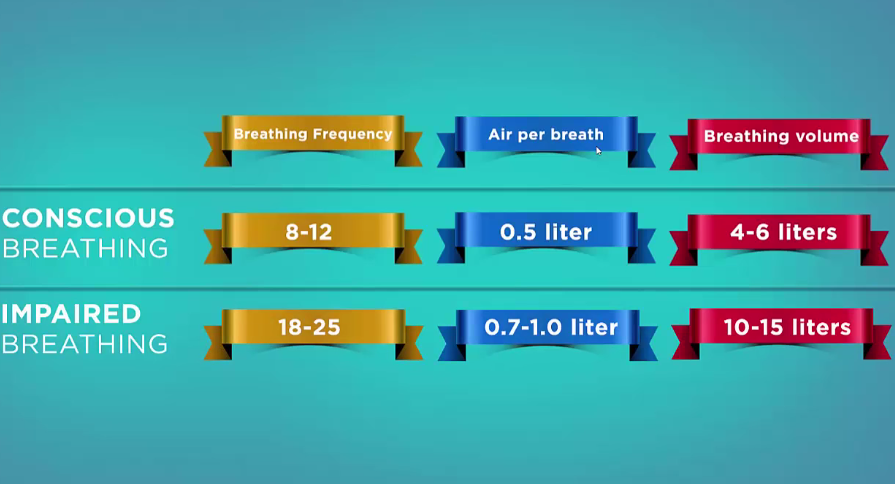
- Maintain a slow, relaxed and rhythmical breathing pattern with a reduced breathing volume.
- When inhaling, the hand on the stomach should move FIRST and it should ALSO move MORE than the hand on your chest.
If the hand on your chest moves first and/or moves MORE than the hand on your stomach, it indicates that your breathing is impaired.

Another way to practice abdominal breathing is to lie flat on your back on the floor (or your iMRS 2000 mat) with a book on your stomach. When you have mastered the art of diaphragmatic breathing, the book on your stomach will move upwards during inhalation and downwards during exhalation.
Hard to breathe shallow doing this.
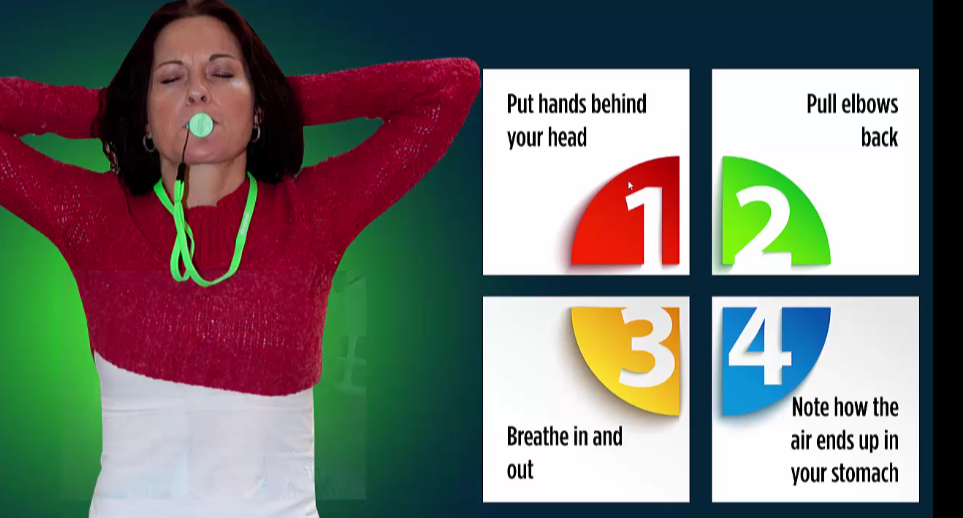

https://www.amazon.com/Breather-Inspiratory-Expiratory-Breathing-Exerciser/dp/B00FE8N7Y4/ref=sr_1_1_sspa
The Relaxator is available at www.consciousbreathing.com
|
|

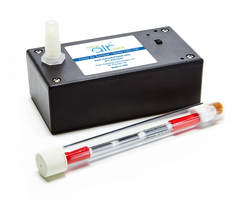
The purpose of BOTH of them is to provide resistance on exhalation.
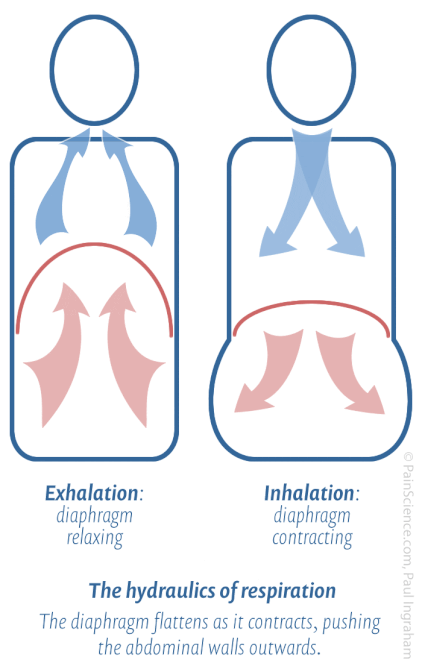
Normal exhalation at rest is totally relaxed and occurs without any muscle activity. Exhalation is also longer than inhalation and a break occurs following exhalation.
**IMPORTANT – When breathing optimally, inhalation lasts for 2-3 seconds, exhalation for 3-4 seconds followed by a pause that lasts for 2-3 seconds
So ideally 3-4-3 (6 breathes a minute) but that is advanced
Start by shooting for 2-3-2 (8-10 breathes a minute).
Though they have resistance settings for inhalation, you will INHALE through the nose.
Benefits to Resistance Exhalations
1) Better Movement of Diaphragm – Upon exhalation with resistance your abdominal muscles pushes your diaphragm higher up which makes your diaphragm go lower on inhalation. This leads to deeper inhalation naturally (more room). You give room for a deeper inhalation. The further diaphragm goes UP on exhale, the further it goes down on inhale.
2) It trains abs and breathing muscles
Diaphragm gets underused and weak.
Strengthen diaphragm and area around diaphragm.
3) Gives Rhythmical breathing
4) Prolongs Exhalation which results in greater relaxation – empties out stale air…(emptying glass before filling)
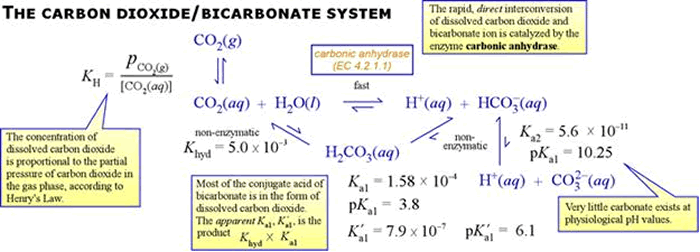
5) You take few breathes per minute those reducing your breathing volume, which increases CO2 in the lungs, improves your CO2 tolerance, dilates the blood vessels, etc.
6) Increased Pressure in lungs increases the ability of the alveoli to transfer oxygen to your blood. Lowered pressure in lungs is COMMON for mouth breathers. Leads eventually to collapsed lung in extreme in COPD and emphysema.
Gas exchange – the bigger the pressure, the more efficient the gas exchange is.
Use it or LOSE IT!!!
To Strengthen Your Diaphragm and Improve Your Breathing
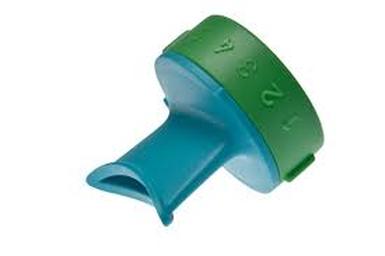
1. Set the Resistance
The aim is for you to achieve a slow, deep, relaxed and rhythmical breathing, so it is recommended that you increase the resistance slowly and gradually to make sure your breathing stays relaxed.
(On The Breather, just focus on the exhale settings which like Relaxator is 1 easiest to 5 hardest).
2. Bring the Relaxator or Breather to your mouth
Let it rest gently between the lips for greatest relaxation. If possible, refrain from biting it with your teeth since this causes your jaw to tense up and increased amount of saliva.
3. Breathe out through the Relaxator or Breather
Exhale slowly and calmly through the Relaxator. At exhalation your abdomen and the lower part of your chest should slowly contract while the upper part of your chest and shoulders remain still.
4. Inhale calmly through your nose
Inhale calmly through your nose — just let the inhalation happen and let the air in. At inhalation the air passes into your abdominal area. Your abdomen slowly expands while the upper part of your chest and shoulders remain still. The lower part of your chest may expand a little. Please note that the main focus when using the Relaxator or Breather should be on the outbreath, since if we get the exhalation right a good, low, diaphragmatic inhalation will follow.
5. Use the Relaxator or Breather AT LEAST fifteen minutes a day (3x 5 Min sessions good too)
An optimal respiration of 8–12 breaths per minute, with 0.5 liters of air per breath is achieved when the resistance is set to 3–4 (that is the goal, not necessarily the starting point. I recommend starting on level 1 for 15 minutes daily). Start SLOW!
Please note that our breathing affects every single aspect of our lives, so if you train to hard in the beginning you may experience cleansing reactions.
Also check out website for other breathing techniques I like
Sandbag, Alternate Nostril, Salt Pipe and More.
Nose Breathing and Breathing Exercises will improve your exhalation time.
More on this in the SPIRIT Module.
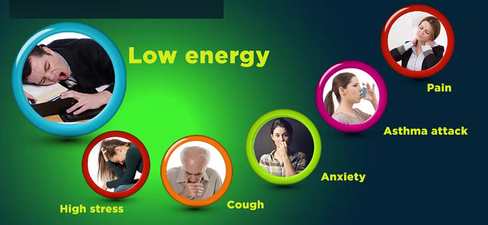
a. Low Energy – Oxygen main energy catalyst
b. High stress to relaxation
c. Cough – inflamed airways… particles in our airways we want to get rid of.
Slow and low… able to with the air itself to bring out the particles.
Don’t need to cough or mucus to bring out the particles.
d. Anxiety – bag breathing… reinhale CO2… does work a little.
CO2 helps to oxygenate brain better.
e. Asthma attack – not lack of asthma medicine that gives the attack.
Not a drug deficiency that makes you sick.
f. Pain
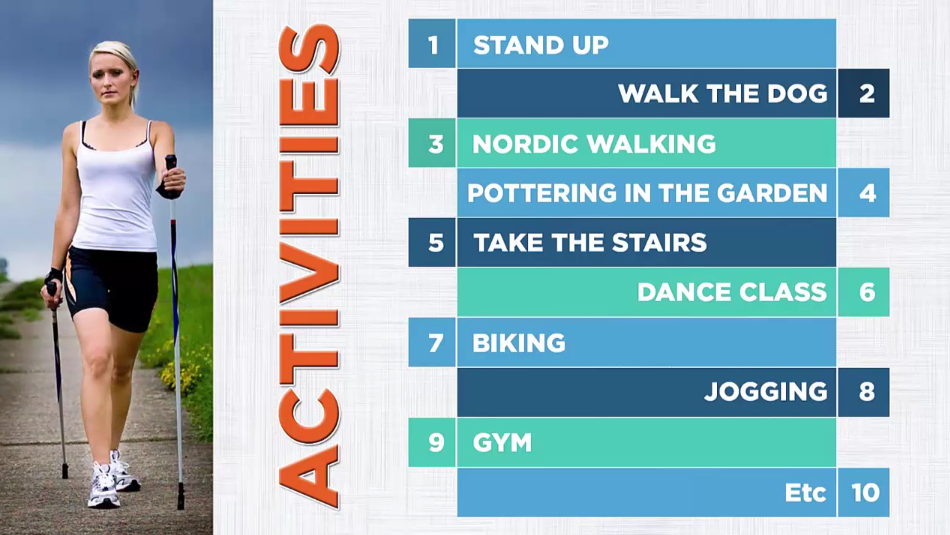
3) Make Sure to MOVE your Body Every Day
Our body does not feel good when we do not move enough.
Increase physical activity.
Apply conscious breathing.
Try to breathe through your Nose during walking and exercise as much as you can.
At a certain point you’ll probably need to breathe through your mouth if it is strenuous
exercise but start trying to build CO2 resistance.
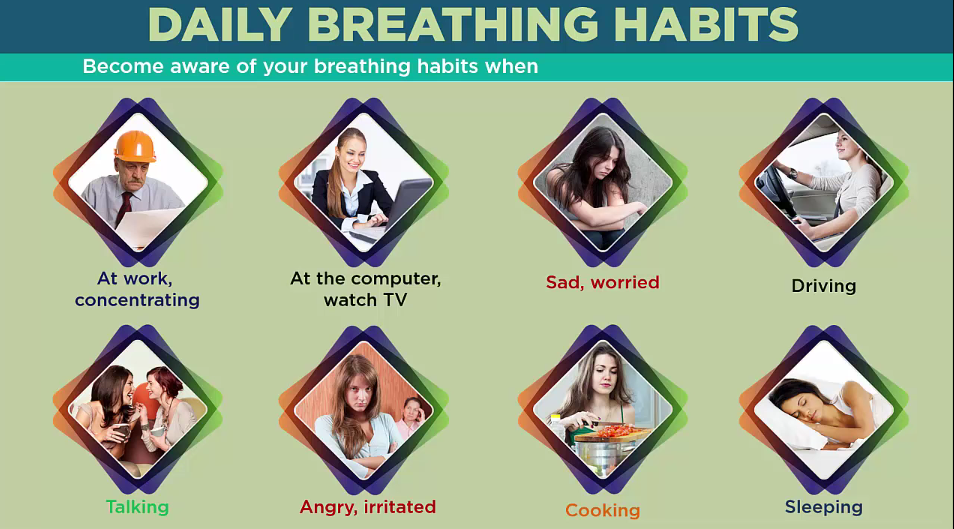
4) Be Aware of Your Breathing
In front of computer concentrating.
Its one thing to know consciously 5 tips
It is another thing to maintain that a minute later when occupied.
Stop breathing while concentrating.
Ligthweight , have it with you.
Retrains breathing habits and helps breathing rhythmically.
How do you breathe??
for example, do you
- Clear your throat when you are stressed (clearing throat is a form of breathing).
- hold your breathe when you concentrate
- breathe forcefully when you talk
- keep your mouth open when you walk or exercise
- snoring when you sleep
Five Tools and Homework!
1) Breathing Tape (sleep/day)
2) Relaxator or Breathing Trainer
3) Physical Activity
4) Breathing awareness (Nose Breathing and Tongue Roof Mouth , Swallowing)
5) The iMRS 2000 For Oxygen Therapy (Does not disrupt O2-CO2 balance like Hyperbarics and other oxygens devices do).
- The iMRS 2000 improves oxygen utilization in the lungs
- The iMRS 2000 improves cellular respiration and mitochondrial function
- The iMRS 2000 improves microcirculation in the capillary bed so your whole body becomes infused with Oxygen which helps to energy all the cells, tissues, organs and organism PLUS it helps to directly kill bacteria, viruses and parasites that HATE oxygen. People that are sick are ALWAYS low oxygen… You just cannot be fully oxygenated and sick..
- Conscious Breathing as outlined in this Module and iMRS 2000 treatments together is a HUGE SYNERGY. Focus on deep belly breathing while laying on the mat.
6) All the Other Elements Food, Water, Light, Posture, etc Enhance Breathing and Oxygen-CO2 balance.
Other Breathing Techniques I like
A. Sandbag Breathing
Lie on your back in relaxation pose, relax and watch your breath for a couple of minutes. Feel how your belly is rising and falling.
Then place a sandbag or something else that weights about 3-10 pounds on the upper abdomen (start slow). Put your attention there. You can use a sandbag, book, brick or whatever works. I have been using a himalayan salt brick with good results. But typically it is recommend to use a sandbag.
Watch and feel the bag rise and fall with the breath. The inhale will be less easy than the exhale, but should not cause stress. Breathe in and out of your nose and let the inhale be as long as the exhale.
Remove the weight on your abdomen and watch your breathing again in relaxation pose.
You can do this practice daily for 5-10 minutes and increase the weight over time. This practice is meant to increase your diaphragm strength, to calm down in the practice and to deepen your connection to your breathing.
*** Variation – Abdominal respiratory exercises with books
Take 2-3 medium weight books or one large phone book and lie down on your back with the books on your tummy. Focus on your breathing and change the way you breathe so that
1) you can lift the books up about 2-3 cm (1 inch) with each inhalation and then relax to exhale (the books will go down when you relax to exhale)
2) your rib cage does not expand during inhalations.
Repeat this diaphragmatic breathing exercise for about 3-5 minutes before your main breathing exercises to reconnect your conscious brain with the diaphragm. You can practice this exercise for some days until you are sure that diaphragmatic breathing is the usual way to breathe during the breathing sessions.
For some people with persistently tense diaphragms, who in addition have problems with slouching and constipation, magnesium can be an additional assisting factor.(A lack of magnesium leads to spasm and tension in body muscles.)
——
B. Alternate Nostril Breathing
Did you know that we breathe through one nostril at a time when our body is in balance?
It is well know in Eastern Wisdom and Western research that our nose behaves in a cyclical way.
The size of the erectile tissue inside the nose increases and decreases to make the airflow alternate between nostrils.
When the airflow goes in and out the right nostril, the left part of the brain is more active and vice versa.
Alternate Nostril Breathing then balances both sides of the brain.
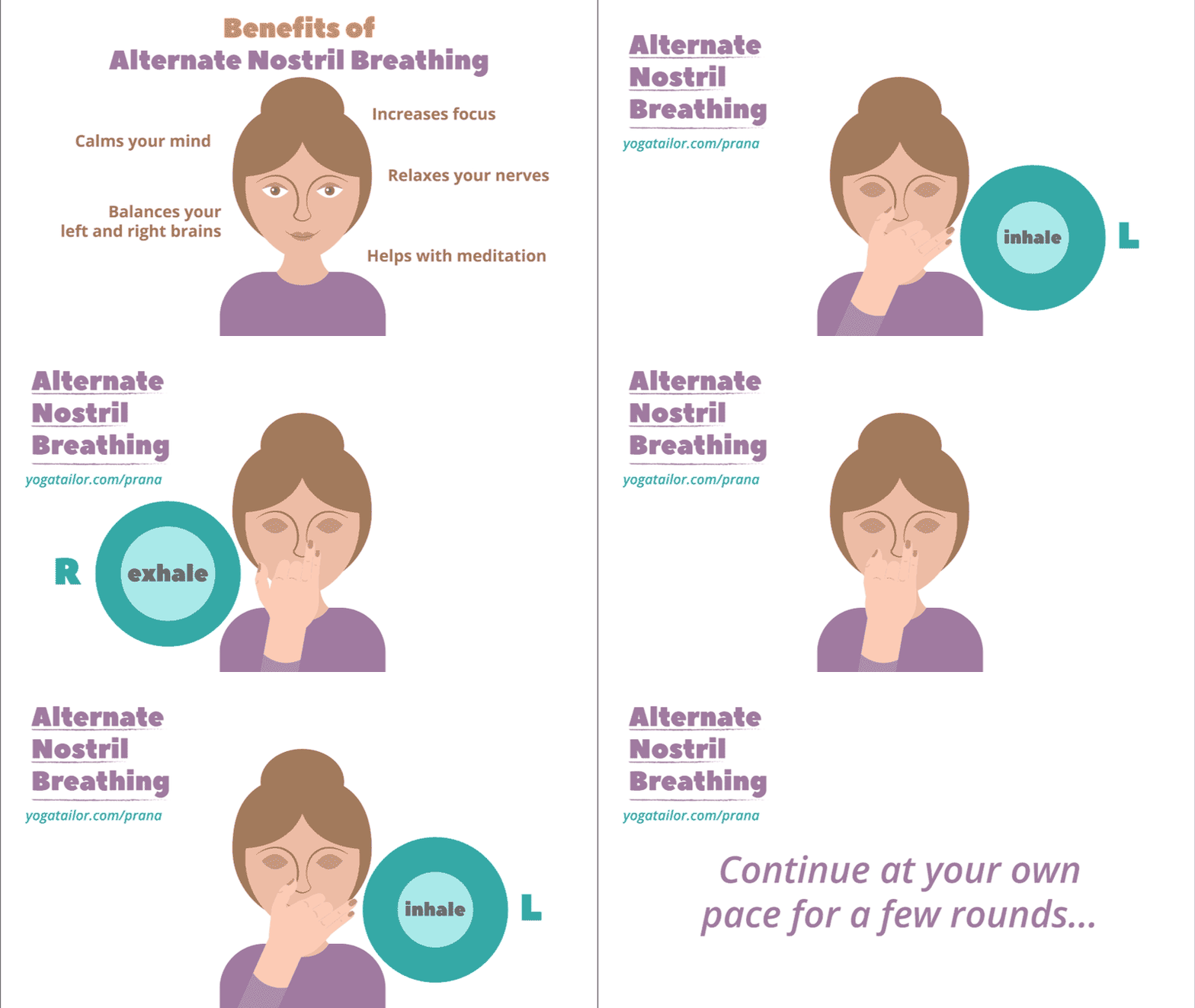
The animation below illustrates Alternate Nostril breathing which is highly recommend before meditation OR just to relax your mind and body. It is also very energizing to the brain and body.
1) Close your left nostril with your finger and inhale through your right nostril.
2) On Exhalation, close our right nostril and breathe out through your left nostril.
3) Again breahe in through your left nostril before you switch again so that the exhalation occurs through your right nostril.
4) Left in, right out, right in, left out….left in, right out, right in, left out… Continue this cycle for 10-20 breathes or until you are relaxed.
C. Breathing In Through Salt Pipe (See Below)
Halo therapy/ Speleo-therapy for Clearing the Sinuses and Lungs
Along with just breathing through your nose, you may initially need a little extra helps clearing the sinuses.
I have tried several and this is the one I really like and use myself.
https://www.amazon.com/Casa-Vita-Himalayan-Inhaler-Travel/dp/B01M696XZK/ref=sr_1_1_sspa
**This is a really good video overview of Salt Therapy ( Halo therapy and Speleo-therapy)… Watch

Himalayan Salt Inhalers (or Salt Pipes) AND NETI POT TO CLEAR AIRWAYS
a GREAT tool to both FOCUS on deep breathing AND breath energized “ocean-like” saltwater air.
Himalayan Salt Inhalers are used to improve the symptoms of allergies, respiratory infection, asthma, smokers cough, dry cough and other respiratory ailments. Himalayan salt has many health benefits, and its use is shown to reduce inflammation, kill bacteria, yeast, and other micro-organisms that cause sinus and respiratory infections.
By simply using a salt inhaler for 15 minutes a day can bring major health improvements.
Salt inhaler therapy (called Halo therapy, and Speleo-therapy) is a natural and effective way to improve respiratory health. This practice has a long and proven history, documented in ancient Europe. People travel from all around the world to visit the salt caves and breathe in the mineral rich air.
Himilayan Salt is Ionic – Ions from negative electrons (Antioxidants)
Dry Inhaler – few minutes to up to an hour for considerable asthma
Breathe in through Mouth and Out through the Nose (watch video below).
Focus on DEEP belly breathing. This is a GREAT combination of breathing exercises and negative ion therapy at the same time.
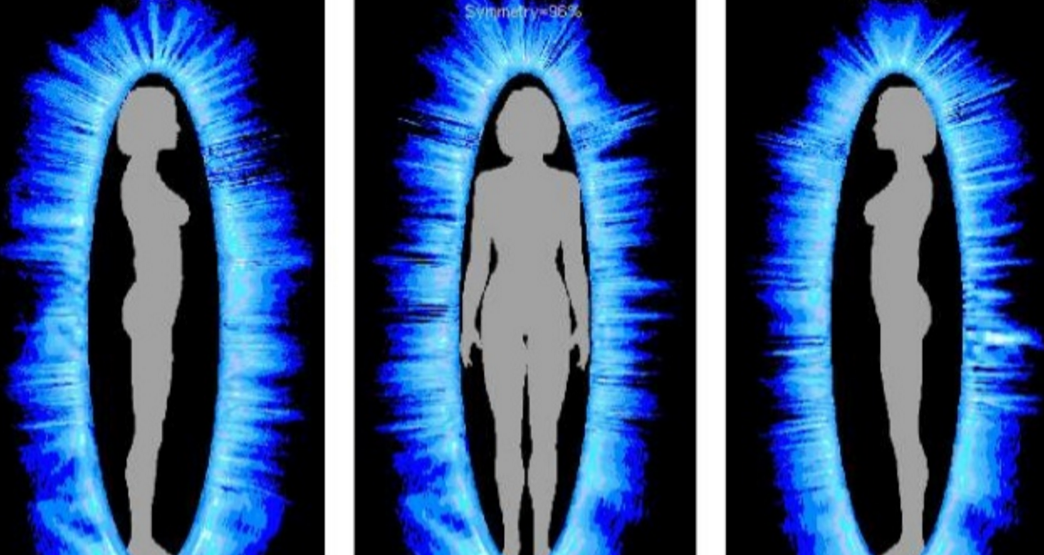
When you breath long slow deep breathes, you bring the ions into the lungs and the ions are so small they bypass nasal filtering… Lungs absorb electrical ions directly into the blood (which goes to the cells) which not only reduces inflammation in the lungs (asthma, pneumonia, emphasema, any lung issue) BUT for healthy people it energizes and electrifies your biofield with Negative Ions and Oxygen and boosts your cellular metabolism and immunity!!
All just by sitting and watching TV while breathing! That’s right. The air you breathe in is drawn across the salt chunks and into your lungs. No batteries, no cord, just Himalayan salt.
12 major obstructions to optimal breathing:
- Mouth Breathing/Breathing too heavily
- Physical/mechanical constriction & poor internal breathing coordination including but not limited to chronic tensions throughout any portion legs, pelvis, abdomen, chest, shoulders, throat and head.
- Airborne allergy or pollutants
- Poor Diet
- Prescription drug side affects
- Non-activity
- Unresolved emotions (The emotions are so closely aligned with the breath that any readjustments by the primitive part of the brain can produce unexplainable and disturbing states of fear, anxiety, aggression, depression, or other unwanted emotions associated with such breathing rhythms.)
- Poor Posture (Module 7 will further explore this)
- Improper Tongue Position
- Poor attitude
- Stress
- Too much time indoors, not enough FRESH air
- Dehydration: Being even slightly dehydrated (which is actually very easy to become in life today), ‘thickens’ your blood, making it harder for oxygen to be transported where necessary in the body – so drink regularly – See module 3.
- Not enough antioxidants
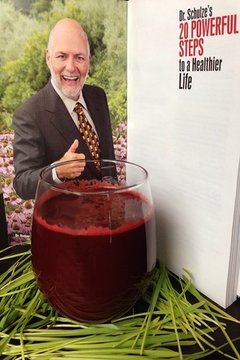
Dr Schultzes Blood Buiding Juice – To Increase Hemoglobin and Oxygen Levels
- Beet Greens
15 leaf480g - Beet Root
1 beet (3″ dia)175g - Carrots
7 medium427g - Kale
2 leaf (8-12″) - His original recipe calls for 2oz of wheat grass instead of kale. We’ve found that about 2 cups of (packed) wheat grass yields 2oz of juice. You can also find variations of this recipe using spinach, Parsley, broccoli, dandelion greens and others. Find a combination that is palatable. You can also try green apple, cucumber, celery as a base. Main thing is start drinking fresh juice daily!!
|
|

to Supplement and Boost Oxygen Hyperbaric, Oxygen Concentrators, EWOT, Activated Air Machines, Air Purifiers, Air Ionizers, and More
Improves Circulation to Alveoli
Increases Oxygen Utilization
Helps Hemoglobin to become more magnetized and bind more strongly to oxygen
Helps with circulation and microcirculation in the capillaries and capillary bed
Improves flow of Oxygen into Mitochondria (TMP)
Enhances ATP production (ATP-ase)
Along with deep breathing of fresh air, natural earth based PEMF like the iMRS 2000 is the best oxygen therapy that there is! Also PEMF helps assist in better circulation to and from the lungs.
7) Beyond Breathing – Meditation and the breathless state. More on this in Module 8
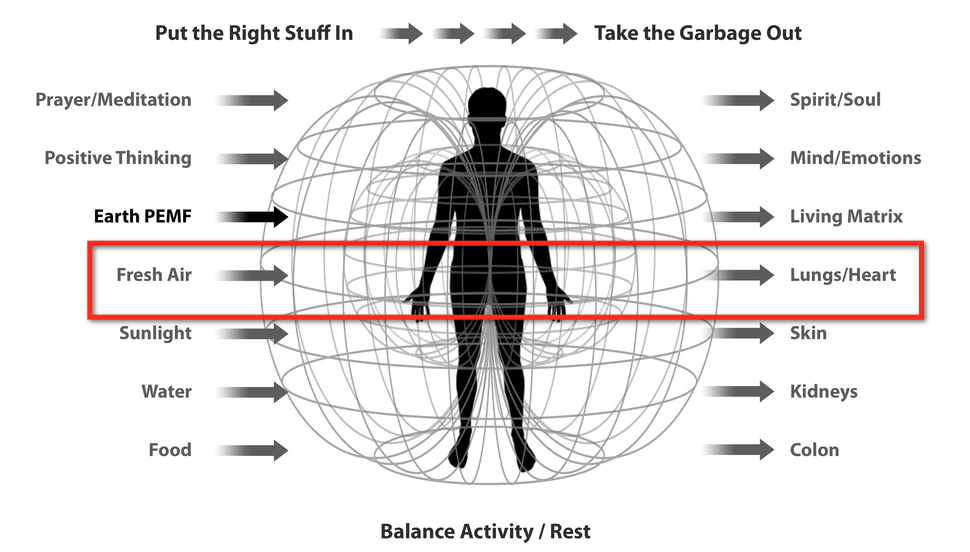
The 4th ELEMENT Air: Oxygen -> Lungs
- Practice deep-breathing exercises (or consciously breathe deep
while walking outside in nature). - Invest in a good indoor air purifier. I also recommend a good air
ionizer and a good HEPA vacuum. - Clean out your indoor pollution by
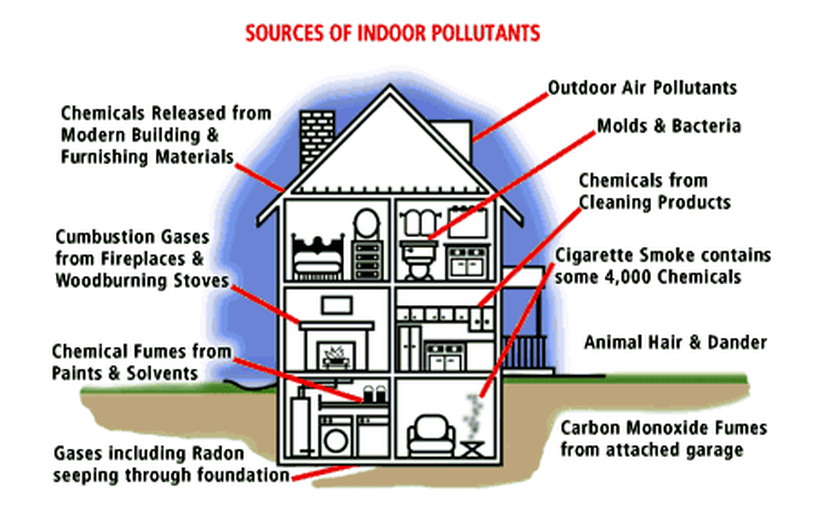
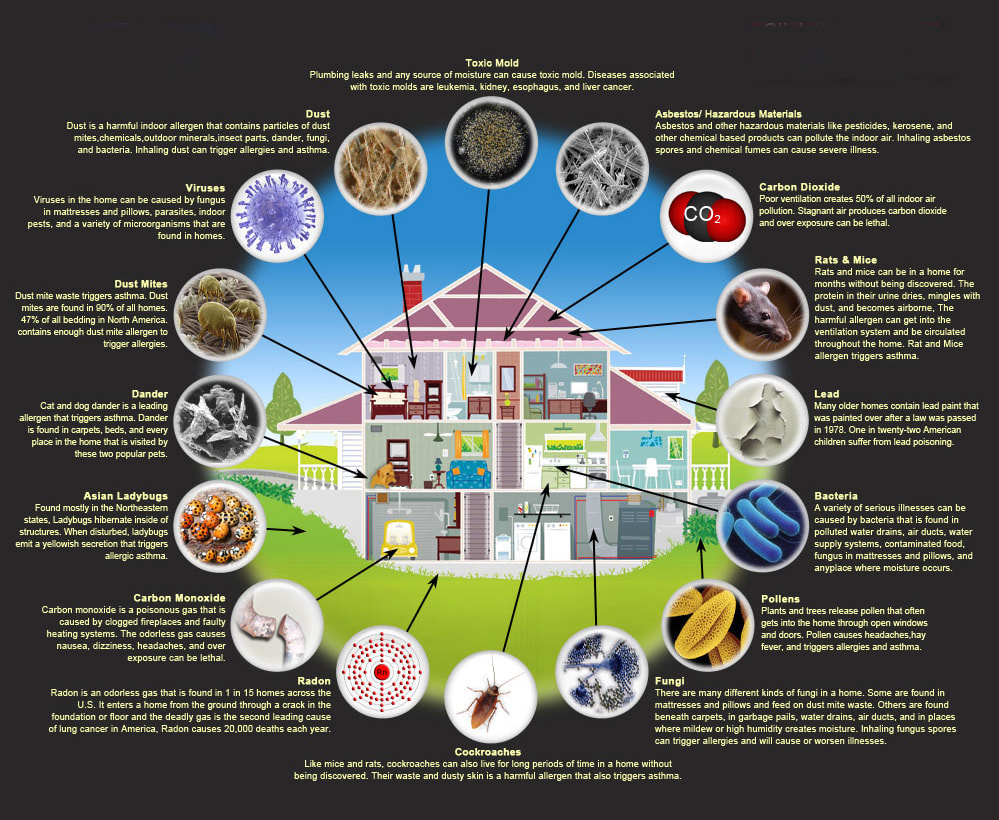
- Keeping your house CLEAN using organic and natural cleaning products (commercial cleaners are toxic). Then there is airborne bacteria, viruses, molds, dust, smoke, paints, solvents, cleaners, detergents, new carpet, new furniture, radon, carbon monoxide, natural gas and hundreds of other chemicals pollute our indoor air at home and in the workplace
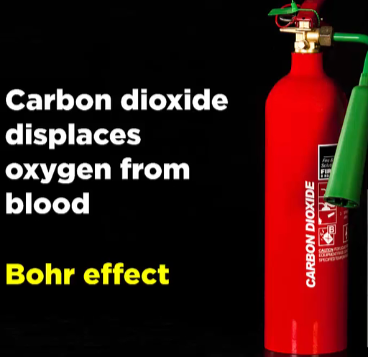
- Focus on getting more FRESH air in your house. Carbon dioxide is harmful and even lethal in high amounts and stagnant households are higher in Carbon dioxide. Even in the winter try to keep your windows cracked and Air out the house.
- Spend more time OUTDOORS in the fresh air as most indoor air is subpar at best. I tell people try to walk 6000-7000 steps a day outside in the fresh air. Focus on deep breathing while you walk.
- I cannot emphasize this enough, clean and fresh air is one of the most important things for your health, perhaps THE most important. If you are sick , you have to move to a climate that allows you to spend a lot of time outside in the fresh air. KEY TO HEALING!!!
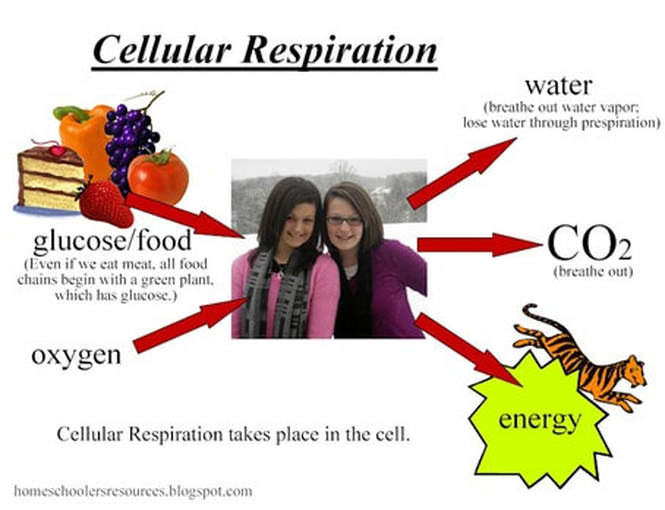
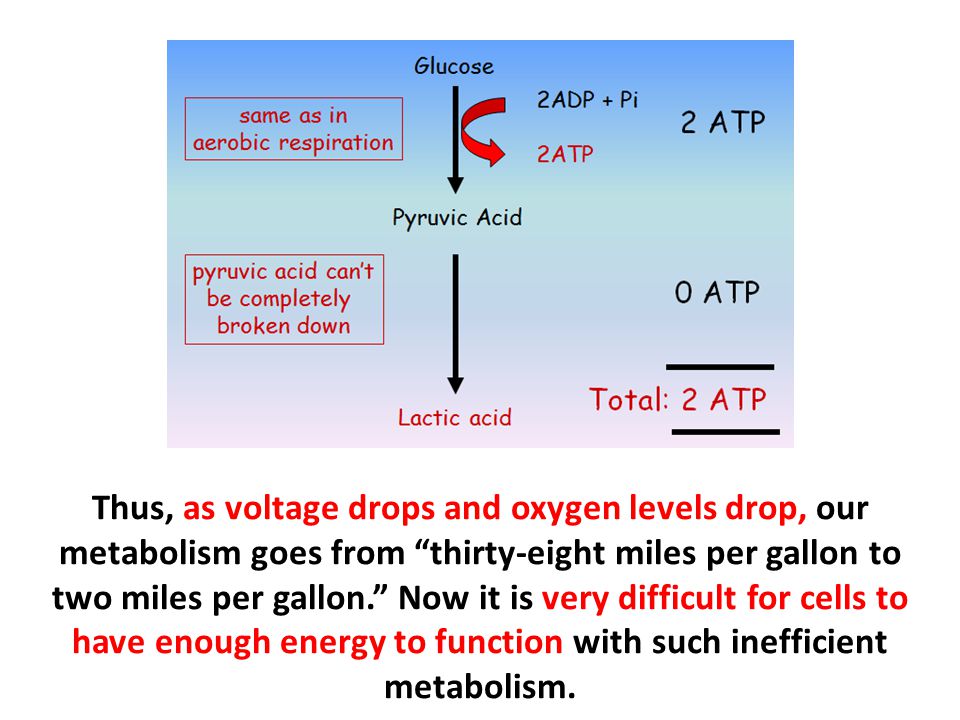
- Remember not ONLY is oxygen the MAIN electron acceptor to CREATE ATP or energy in the body (Aerobic respiration yields 38 atp vs only 4 for anaerobic). But also Oxygen KILLS Bacteria and viruses and many are anaerobic and do not have the antioxident mechanisms to handle oxygen. Bottom line, your Cells LOVE oxygen and Pathogens HATE IT… WIN WIN when it comes to health.
CYCLES & RHYTHMS AIR
- Spend as much time outside in the fresh air during the day. Walking, gardening, yard work, sports, beach, hiking, etc. Try to walk barefoot if you can on grass/beach for extra electrons, and earth energy.
- At night keep your room cool and a window always cracked. Bundle up. Not only does the body sleep better in cooler temperatures, but the fresh air will help you to wake up energized. VERY IMPORTANT!!
My Favorite Air/Oxygen Resources
- IQ Air Purifier, Austin Air is also very good. Get a model that matches your square footage needs. Great Investment!
- Get an air ionizer – Research amazon for best reviewed OR buy several himalayan Salt Lamps and Place them all over your house…AS MANY AS POSSIBLE!! Best NATURAL source of negative ions
- Get a Himalayan Salt Pipe and try to breathe 50-100 deep breathes a day in the fresh air. I have tried several and THIS is my favorite one.
https://www.amazon.com/Casa-Vita-Himalayan-Inhaler-Travel/dp/B019PUPSGG/ref=sr_1_5_a_it - Dr Schultze Air detox (Herbdoc.com) Spray around the house once every week (or more often if there is an infection in the house with family member).
- Invest in organic Soap, toothepaste, mouthwash, surface cleaners, furnature polish, toilet cleaners, window cleaners, Detergent for your clothes… BASICALLY ANYTHING YOU USE TO CLEAN YOUR BODY, CLOTHES, HOUSE and CAR… ALL ORGANIC and ALL NATURAL. Do not COMPROMISE on cheap and toxic bleach based, lye based cleaners etc… I cannot emphasize this enough… There are too many too list here, but basically get your cleaners at Whole foods or your local health food store.
——
Other Stats to Help Visualize the Sheer Volume of Air we Breathe!!
The average adult, when resting, inhales and exhales about 7 or 8 liters of air per minute.
That totals about 11,000 liters of air per day. 3000 Gallons of Air A DAY!!
The air that is inhaled is about 20-percent oxygen, and the air that is exhaled is about 15-percent oxygen, so about 5-percent of the volume of air is consumed in each breath and converted to carbon dioxide. Therefore, a human being uses about 550 liters of pure oxygen (19 cubic feet) per day (145 Gallons).
This is a little more than half a cubic meter approximately equal to the volume of two bathtubs or the trunk of a large car.
Each day we inhale 550 litres O2(.8Kg=1/8 Pounds) and Exhale 500 Litres Co2 (1 KG Co2= 2.2 Lbs). BALANCE is the KEY!!
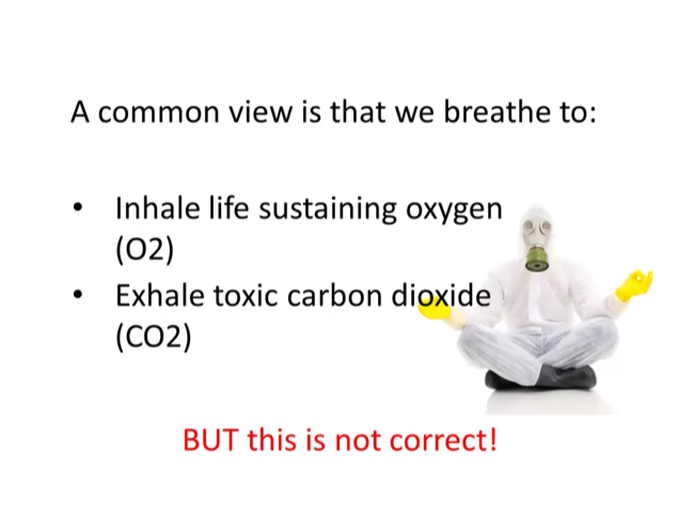
Also Interestingly we exhale 100x more CO2 than we inhale.
Inhalation (20% Oxygen/ .04% Carbon Dioxide)
Exhalation (16% Oxygen/ 4% Carbon Dioxide)

This is a MAJOR Theme in this course
1) Avoid Intense Radical Diets and Megadosing of Supplements
2) Avoid Ionized and Unnatural Waters
3) Avoid High Intensity Lights, Oversunbathing, UV tanning beds, Light Boxes.
4) Avoid DEEP and High Intensity Breathing and Oxygen Concentrators
5) Avoid High Intensity PEMF and other High Intensity Energy Medicine Devices
6) Avoid High Intensity Whole Body Vibration and Overtraining in General
Section on the Hormesis Effect!! Understand Life is a Delicate Balance and We have evolved for millions of years with nature so we need to Reconnect to nature’s perfect balance of elements.
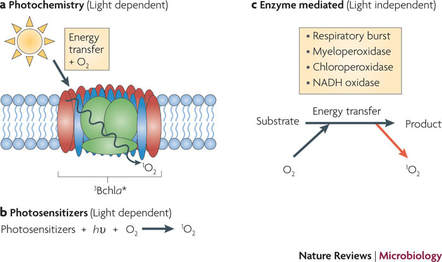
In nature, energy from our sun activates chlorophyll in plant leaves that transforms the oxygen produced by a plant to a higher-energy status. Nature actually rearranges the electrons in the oxygen molecule to create “singlet oxygen.” This energetically charged air boosts your body’s ability to use oxygen, drastically increasing your cellular energy and optimizing your cell metabolism. More importantly, your optimized cell metabolism actually absorbs and captures dangerous free radicals.
Results from studies using athletes that train with Activated Oxygen:
- A minimum of 8% more energy generation
- An average of 10% reduction in unused exhaled oxygen
- A 10% reduction in resting heart rate
- A minimum of 7% less lactate production
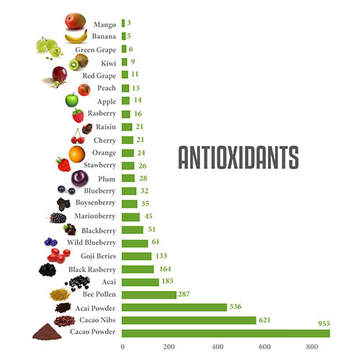
Hence, the “Oxygen Paradox.” How can we increase oxygenation – the positive cellular utilization of oxygen needed for optimal function and healing – without simultaneously increasing oxidative stress – the negative, reactive effects of free radical damage and other consequences of weakened antioxidant systems is by getting as much Fresh air as possible in this energized state ALONG with an antioxidant rich diet.
===Aside Oxygen Creates Free Radicals (Research I did at Georgia Tech===
But Oxygen is a double-edged sword. On one hand, our cells thrive when they get the oxygen they need to freely synthesize ATP, which is the nearly universal “molecular currency” of cellular energy exchange. When your cells have an ample supply of ATP, your tissues heal and regenerate faster, metabolic pathways work better, your nervous system stays attuned and your immune responses become more focused and effective.
On the other hand oxygen is also enormously reactive. 6% of all oxygen becomes the superoxide radical and other Reactive oxygen species (ROS) such as the hydroxyl radical, hydrogen peroxide, and peroxynitrite. These ROS are a type of free radical, which in simple terms is a molecule with “unpaired” electrons. They’re kind of like exhaust from your car. As oxygen travels through your blood stream, it’s picked up by your cells and converted into energy. Like the carbon monoxide that comes out of your tail pipe, excessive free radicals are an unfortunate by-product. Because unpaired electrons naturally look for mates — they actually steal electrons from other atoms and alter the molecules two which they react. When free radicals (includingROS) alter polyunsaturated fatty acids in membrane lipids, proteins, and DNA, you damage not just our cells but even the DNA in your mitochondria. but luckily we have mainly antioxidant systems to cope – S.O.D, Glutathione, etc PLUS antioxidants from the diet.
One of the main theories of aging is the Free Radical theory and just as the sun can be overdone, so too can oxygen… Note Marathon Runners seem to experience accelerated again UNLESS they do a rigorous antioxidant program. Also many Oxygen therapies of force feeding the body with Oxygen ARE NOT ideal (hyperbarics, etc). Better to focus on learning how to breathe more deeply.
Singlet oxygen as found in Nature is an energized state of Oxygen produced by plants during photosynthesis… So Oxygen is not just oxygen… there is good and better and too much and not enough.
====
C. THE RESPIRATORY SYSTEM
Dramatically aids in relief of many long term respiratory difficulties such as asthma, bronchitis, COPD
Opens up the chest to make breathing easier and fuller, which facilitates strengthening of the life force, emotional stability and mental clarity
Maintains blood acid alkaline balance which supports optimal cellular function
D. CIRCULATORY SYSTEM
Improves blood circulation and relieves congestion
Increases supply of oxygen and nutrients to cells throughout the body
Increases flow of oxygen-to-oxygen loving organs such as the brain and eyes Eases the strain on the heart by increasing oxygen to the heart
Pumping: = Think of the deeper breath as both an energy and vital fluid pump. It is actually a much larger pump than the heart is.
E. THE NERVOUS SYSTEM
Calms a chronic “fright or flight” anxiety state by reversing the breathing patterns which began at the time of the original trauma
F. THE DIGESTIVE SYSTEM
Proper diaphragmatic action acts as a pump to massage the internal organs, significantly aiding their function
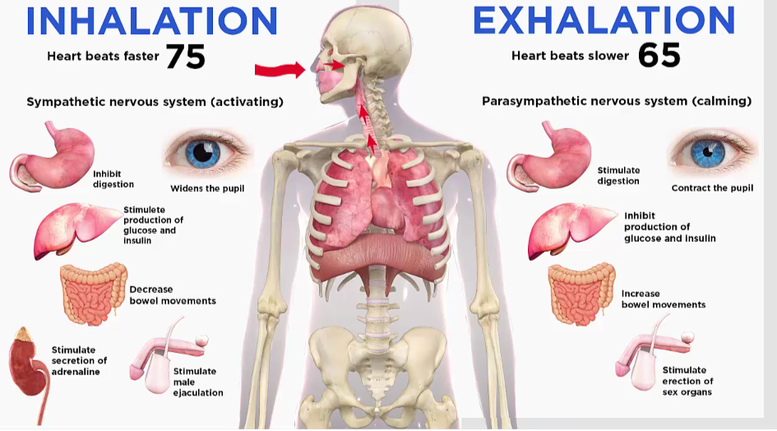
Optimal breathing calms the emotions which in turn allow the digestive system to stay in a stronger expression of parasympathetic rest, digest and heal.
G. URINARY SYSTEM
Excess water (in the form of vapor) is expelled
Reduces swelling of the body (edema)
Decreases stress on organs of elimination, thus helping the body to naturally cleanse and tonify
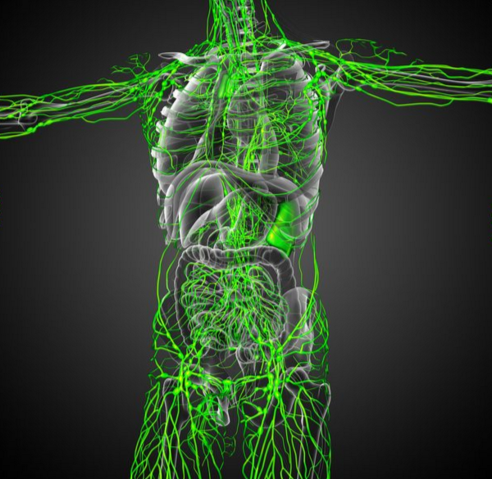
H. THE LYMPHATIC SYSTEM
Increases depth and continuity of lymphatic fluid circulation which plays a crucial role in eliminating toxic wastes and strengthening the immune system
Helps speed recovery after major illnesses
I. MUSCULAR/LIGAMENTS
Relaxes muscle spasm and relieves tension.
Helps increase the supply of blood and nutrients to muscle
Upper body strength is directly affected by proper breathing
J. STRUCTURAL
Releases and reduces muscular tension
Helps increase flexibility and strength of joints;
when you breathe easier you move easier.
Can partially compensate for lack of exercise and inactivity due to habit, illness or injury
K. PHYSICAL APPEARANCE
Healthy breathers look more rested and vibrant
Reduces wrinkles due to improved circulation and blood oxygen flow Results in radiant skin at any age
L. WEIGHT LOSS – breathing affects weight.
Not many diets have improved breathing as a key ingredient!
We deprive our body of oxygen with improper breathing and in order to burning fat in the mitochondria we need oxygen.
With low oxygen, less fat is BURNED and more fat is GAINED.
L. MENTAL
Improves power of mental concentration and observation
The brain is an oxygen-loving organ; supplying greater oxygen to the brain naturally enhances its performance
M. EMOTIONAL
Produces profound relaxation and inner peace
Reverses effects of stress related to self-defeating habits and tendencies, including childhood traumas, religious programming and cultural conditioning.
The breath rhythms adjust to subconsciously stored emotional traumas, resulting in biological disturbances. The emotions are so closely aligned with the breath that any readjustments by the primitive part of the brain can produce unexplainable and disturbing states of fear, anxiety, aggression, depression, or other unwanted emotions associated with such breathing rhythms.
This is why even folk remedies such as “take a deep breath” can be amazingly effective when we encounter emotional storms. If you promise yourself to take breaks to just do three conscious breaths, you’ll be astounded at how centering such a small practice can be.
N. SPIRITUAL
Deepens meditation or spiritual connection
Heightens intuition
We are most connected with our emotional and energetic physical bodies when we are consciously connected with our breath. In many cultures, the word for “breath” can also be translated as “soul” or “spirit.” This is why ancient peoples have placed so much importance on being aware of one’s breathing. While it might seem very challenging to be constantly monitoring our breath, we can at least take designated breaks throughout our day to get in touch with our real self…
Peter
According to Li Qing Yun (reported to have lived over 250 years) nourishing the immune and circulatory systems by breath control and exercising the lower abdominal area daily was one of his secrets to longevity. If the qi (chi) is obstructed, the blood stagnates and illness follows. This is because the qi and the blood flow together. The first purpose of working with your breath is to oxygenate the blood, then to move waste materials and toxins out, then to introduce a balancing pressure of qi internally and finally to make to the breath serene and have a calm disposition.
In deep meditation breathing, there comes a point where the breath naturally suspends itself after exhalation. In this unforced state thoughts are also in suspension, as the cells of the body are packed with qi (chi, prana, vital force etc…). There are three stages the body passes through. 1, it becomes very hot, especially the lower abdomen. 2, tremors and involuntary movement of limbs (the original discovery of qi gong) 3, unusual physical strength, mental clarity and tranquility. This natural, unforced manifestation makes the flesh radiate a luminessence and is the secret the yogi and Taoist “immortal” have acquired through their practice.
This happens automatically after a long time of practice. It’s like the Taoist image of the turtle which can live for great lengths of time without breathing, the adapt pulls in their senses into this suspended state of no-mind. Again, mind and breath mirror each other, stop one and the other stops as well. But, again, this isn’t forced. It’s the result of long practice mostly in solitude.
By controlling breath the vagas nerve is stimulated thereby allowing the medulla oblongata (brain stem) to regulate the action of the heart and lungs etc… slowing them down dramatically. As the breath deepens and slows, perfect health follows and aging is stalled. When one has learned to regulate the length of inhalation and exhalation to where they are both of equal duration, health and spiritual power result. The ancients assigned four heart beats for each breathing action, that is the optimal length of inhalation vs exhalation. For every minute of practice the accumulated pressure of the qi (prana or vital life force) will vitalize one hour of life. Therefore, setting aside time each day will greatly extend your life span.
ELEMENT AIR
Element Air / Gases- Air, Sound, Pressure, Vibrations
INTERCONNECTED STRUCTURE – SOUND – VIBRATIONS – PHONONS, PRESSURE WAVES
Physics – Acoustics, Hymatics, Aeronatics, Thermodynamics, waves, vibrations, quantum
**Ringing the cosmic bells
Cosmic Vibrations – sounds waves/acoustic waves from the early universe remain as countless ripples on the cosmic scale that played a part in the distribution of galaxies (peaks of the waves more material, like sound waves. Cosmic background radiation
http://background.uchicago.edu/~whu/SciAm/sym2.html***
CELL – New view respiration
Quantum Biology – Sense of Smell (quantum vibrations)
Breathing/Exercise – day…Meditation relaxation night
Prana Vayu: Seated in the heart/chest, Anahata Chakra, Air
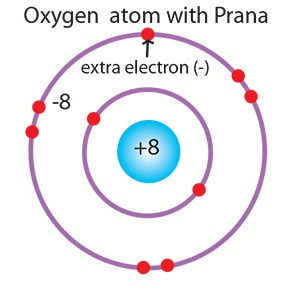
Breath = Lifeforce/Prana
Air Practices – Breathing Deeply Fresh, Clean and Energized Air, Yoga/Breathing and Pranayama
Oxygen Therapy TECH – EWOT, Ozone, Hyberbaric, etc.
Subtle Energy Medicine – gentle oxygen therapy
Singlet oxygen, energized air.
Sound/Vibrational healing
Put right stuff in, take garbage out.
Activity – Cardio, Interval training, Deep Breathing. EWOT,
Rest – Slow breathing, fresh air